Bank of America Internship Application Process (2026): Stages, Video Interview and How to Get In
The Bank of America internship application process 2026: every stage, video interview questions, the Spring Insight assessment centre and how to get in.
By Oliver Cordingley ·
In brief
- Bank of America's spring route is the Spring Insight programme: 3 in-person days plus a Day 4 assessment centre that can convert into a summer internship.
- The application is a CV upload plus competency questions, followed by an asynchronous video interview of 5 questions.
- The video interview gives you 30 seconds to prepare and around 2 minutes to record each answer, and the final question is usually about a recent markets story.
- Applications are reviewed on a rolling basis, so getting in early matters more than a perfect final draft.
- London covers Banking, Markets, Global Payments Solutions and Enterprise Credit. Chester covers Global Technology and Global Operations.
- You need to be on course to finish your degree in 2028 and hold at least 112 UCAS points.
The Bank of America internship application process is more structured than most candidates expect, and that works in your favour once you know what each stage is really testing. This guide breaks down the full route in 2026, from the online application and the recorded video interview to the Spring Insight assessment centre, plus the questions you will be asked and how to answer them.
Bank of America internships in 2026: what is on offer
Bank of America runs two main early-career routes in the UK. The Spring Insight programme is the entry point for people in the earlier years of a degree, and the Summer Analyst internship is the longer paid placement that often leads to a full-time offer.
The Spring Insight programme is Bank of America's version of a spring week. It runs in person over 3 days and ends with an assessment centre on Day 4 that can lead straight to a summer internship if you perform well. Where you apply depends on the division you want.
| Detail | Info |
|---|---|
| Programmes | Spring Insight (spring week), Summer Analyst internship |
| London divisions | Banking, Markets, Global Payments Solutions, Enterprise Credit |
| Chester divisions | Global Technology, Global Operations |
| Spring Insight length | 3 in-person days plus a Day 4 assessment centre |
| Deadline | Rolling. Apply early |
| Eligibility | On course to finish your degree in 2028, minimum 112 UCAS points, aged 18 or over |
The rolling deadline is the part most people get wrong. Bank of America reviews applications as they arrive rather than waiting for a fixed cut-off, so a strong application submitted in October is worth far more than a flawless one submitted the week before the listing closes. Once enough people are already progressing, the pipeline quietly fills up.
The Bank of America internship application process, stage by stage
There are 3 core stages for the Spring Insight route: the online application, a recorded video interview, and the in-person assessment centre. Direct internships and placements follow the same first two stages and then swap the assessment centre for a final interview with an analyst. Technology placements add a presentation and a technical interview on top.
| Stage | What happens | Typical timeline |
|---|---|---|
| 1. Online application | CV upload plus competency questions | 30 to 60 minutes to complete, up to 2 weeks for a response |
| 2. Video interview | 5 recorded competency questions | A few days to complete after the invite, then up to a few weeks for feedback |
| 3. Assessment centre or final interview | In-person insight days and a Day 4 assessment centre, or a final interview with an analyst | Up to 2 weeks for a decision |
Stage 1: Online application
The online application takes 30 to 60 minutes. You provide your education, your predicted or current grades, your contact details, and answers to a few Bank of America specific questions about your motivation and the division you want.
One detail matters more than any formatting tip: Bank of America does not use the online form to auto-reject you on keywords. The recruiter attaches your written answers to your video interview and reviews both together. That means consistency across the two is what gets noticed, not a CV stuffed with phrases lifted from the job description.
This is worth understanding properly, because the myth that an applicant tracking system silently bins your CV on a missing keyword costs candidates hours they should spend elsewhere. What actually filters you first are the knockout questions on the form, the right to work in the UK, the UCAS points, the graduation year. If you clear those, a human reads the rest. We break the mechanics down in full in our guide on how applicant tracking systems actually work.
So the job at this stage is relevance, not optimisation. The data backs it up: across a study of 1.7 million applications, tailored CVs converted to interviews at roughly twice the rate of generic ones, around 1 in 17 against 1 in 33. That gap is about a recruiter spending 6 to 10 seconds on your CV and immediately seeing why you fit the division.
How to approach it:
- Pick one division and build your answers around it. A Markets application and a Global Operations application are not interchangeable.
- Use specific evidence. "Built a discounted cash flow model in Excel for a stock pitch competition" lands harder than "strong analytical skills".
- Match your written motivation to what you will say on camera. If your form talks about client work and your video talks about coding, that inconsistency shows.
- Answer the eligibility questions honestly. No CV edit rescues an application that fails a knockout question.
Stage 2: Video interview
Once your application is in, you are invited to an asynchronous video interview. There is no live interviewer. You record yourself answering set questions and a recruiter reviews them later.
The format is consistent: 5 competency questions, 30 seconds to prepare each one, and around 2 minutes to record your answer. You do not need to fill the full 2 minutes. A tight 75 to 90 second answer beats a rambling one every time. The final question is usually about current events in financial markets, so have one recent story you can talk about with a point of view.
Questions you might be asked:
- Tell us about yourself and why you want to work at Bank of America.
- Why do you want to join this specific division, for example Global Markets.
- Describe a time you worked in a team to achieve a goal.
- Describe a situation where you had to learn a new process quickly to perform.
- Talk us through a recent financial markets story and why it matters.
How to prepare:
- Set up a quiet, well-lit space with a plain background and dress as you would for a live interview.
- Write bullet points for the likely questions beforehand and keep them just off camera. Do not read a script, the delivery goes flat the moment you do.
- Use the 30 seconds of prep to choose your example and your first line, then look at the camera, not at yourself.
- For the markets question, pick a story tied to a Bank of America division and be ready to say what it means, not just what happened.
Hundreds of candidates inside the free community are working on Bank of America and other Tier 1 finance applications right now. Join them for free.
Stage 3: Assessment centre or final interview
What comes next depends on the route.
For the Spring Insight programme, the strongest performers are invited to 3 in-person days followed by an assessment centre on Day 4. Across those days you take part in breakout sessions, case studies and simulations, and you meet people from the business. Day 4 is where the assessment happens, and it is the stage that can convert your spring week into a summer internship offer.
For a direct internship or placement, the final stage is usually a phone interview with an analyst, often in the evening. It is motivation and competency based rather than technical. You are being assessed on whether your interest in Bank of America is genuine and specific.
Technology placements go further. You can expect a competency interview, a 10 minute presentation on a topic you are given about a week in advance, and a technical interview. A classic technical prompt is "how would you explain cloud computing to a child", which is really testing whether you can make something complex simple.
Across every version of this stage, two things separate the people who get offers. First, specific motivation. When you are asked why Bank of America, a generic answer about a "great culture" is forgettable, so tie it to a division, a recent piece of news, or the way the bank works. Second, be careful when they ask which other firms you have applied to. Mention similar banks, not a scattered list across unrelated industries, because that signals you actually know what you want.
How to answer using the 3-part story arc
Bank of America's competency questions are behavioural, which means they want a real story with a clear result, not a list of adjectives. The cleanest way to structure one is a 3-part story arc: context, action, resolution.
- Context. Set the scene in one or two sentences. Where you were, what the goal was, what the problem was.
- Action. What you specifically did. Not the team, you. This is where most answers collapse into "we", so keep it personal and concrete.
- Resolution. The outcome, ideally with a number. What changed because of what you did, and what you took from it.
Worked example for "describe a time you worked in a team to achieve a goal". Context: your society needed to raise £2,000 for an event in 6 weeks and sponsorship had stalled. Action: you took ownership of outreach, built a list of 30 local firms, and personalised every email around what each one would get back. Resolution: you closed £2,400 in 4 weeks, and you learned that a targeted approach beats a mass one. That is a complete answer in under 90 seconds, which is exactly what the video interview format rewards.
One warning from real coaching sessions: do not try to memorise every keyword from the job description and force it into your answer. The person reviewing you does not have the description in front of them counting how many times you said "stakeholder". Over-engineered answers sound robotic, and they consistently underperform natural ones.
Common mistakes to avoid
- Treating the CV as a keyword game. Bank of America reviews your CV against your video answers with a human eye. Relevance to one division beats keyword density every time.
- Applying to five divisions at once. Your full application history is visible internally. Applying to Markets, Banking and Technology in the same week reads as scattered, not keen.
- Leaving it late. Rolling review means the earlier you apply, the more open spots there are. This is the single most common and most avoidable mistake.
- Generic motivation. "I want to work in banking because it is fast paced" tells them nothing. Name the division and give a specific reason.
- Filling the full 2 minutes on video. Length is not depth. A focused answer with a clear result is stronger than one that runs to the buzzer.
Proof that a system beats guessing
Most people who eventually land finance internships did not start with a stronger CV. They started with a clearer target and a repeatable process for every application.
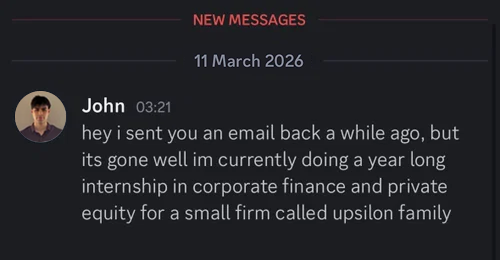
John came in unsure of his direction and applying without a clear focus. Once he rebuilt his CV around one specific target and applied with a system rather than at random, he landed a year-long corporate finance and private equity internship.
John is one of hundreds of candidates inside the free community working on Tier 1 finance applications right now. Join them for free.
Related guides
- J.P. Morgan Spring Week for a peer bank's spring route and HireVue questions.
- HSBC Summer Internship for another UK banking internship broken down stage by stage.
- Lazard HireVue Questions for deeper preparation on the recorded video interview format.
Get your Bank of America application working
If you have been through the Bank of America internship application process before and stalled at the video interview or the assessment centre, the fix is rarely one more rewrite of your answers. It is usually a sharper target division, a CV that reads as relevant in 6 seconds, and applying early enough to be in the pipeline while it is still open.
Join the free community with hundreds of other candidates working on Bank of America and other Tier 1 finance applications right now. Join for free.
Questions candidates ask
- How many stages are in the Bank of America internship application process?
- The Spring Insight route has 3 core stages: an online application with a CV upload and competency questions, an asynchronous video interview with 5 questions, and an in-person assessment centre. Direct internships and placements replace the assessment centre with a final interview, and technology placements add a presentation and a technical interview.
- What is the Bank of America video interview like?
- It is a recorded, asynchronous interview with no live interviewer. You get 5 competency questions, 30 seconds to prepare each one, and around 2 minutes to record your answer. The final question is usually about a recent financial markets story, so prepare one you can discuss with a clear point of view.
- When should I apply to Bank of America's Spring Insight programme?
- As early as you can. Applications are reviewed on a rolling basis rather than against a fixed deadline, so places fill up as strong candidates progress. An early, well-targeted application beats a late, polished one.
- What are the eligibility requirements for Bank of America internships in the UK?
- You need to be on course to finish your degree in 2028, hold at least 112 UCAS points at A level or equivalent, and be aged 18 or over. London hosts Banking, Markets, Global Payments Solutions and Enterprise Credit, while Chester hosts Global Technology and Global Operations.
- Does Bank of America's spring week lead to an internship?
- Yes. The Spring Insight programme runs over 3 in-person days and ends with an assessment centre on Day 4. Perform well there and it can convert directly into a summer internship offer.