Bank of America Spring Week 2027: How to Apply and Get In
Bank of America Spring Week 2027: how the Spring Insight programme works, the video interview, the Day 4 assessment centre and how to get a place.
By Oliver Cordingley · · Updated
In brief
- The Bank of America spring week is the Spring Insight programme. The 2027 intake covers Banking and Markets, Global Payments and Enterprise Credit, and Corporate Functions and Strategy in London, plus UK Operations in Chester.
- Getting in takes 2 steps: an online application with your CV, then a recorded video interview of 5 questions.
- The programme ends with an in-person assessment centre on Day 4. Perform well there and you can be invited onto the June to August 2027 summer internship.
- Recruiting is rolling. The last cycle closed on 23 November 2025, and places were filled before that date, so apply as soon as the window opens.
- Last cycle asked for at least 112 UCAS points and accepted any degree subject. You do not need to be studying finance.
The Bank of America spring week is officially called the Spring Insight programme, and it works differently from most spring weeks. The final day is an in-person assessment centre that can lead straight to a summer internship offer. The programme is aimed at people early in a degree, runs in London and Chester, and recruits on a rolling basis. This guide covers what the Bank of America spring week involves, each application stage, the video interview questions, and how to get a place before it fills.
What is the Bank of America spring week?
Most people search for the Bank of America spring week, but the bank calls it the Spring Insight programme. It is a short, structured look at how the bank works. You get spotlight sessions on each business area, breakout sessions, case studies and simulations in the division you pick, networking with people from the business, and guidance from recruiters on interview preparation.
The part most candidates miss is the end of the programme. Day 4 is an in-person assessment centre, and the people who do well there can be invited straight onto the summer internship. At most banks a spring week gives you a better chance of an internship. At Bank of America the spring week includes the internship assessment. That changes how you should prepare. You are being assessed during the programme, not only before it.
It is aimed at people in the first year of a 3-year degree or the second year of a 4-year degree. Any degree subject is accepted.
Key facts
| Detail | Info |
|---|---|
| Programme | Spring Insight Week 2027 |
| London divisions | Banking and Markets, Global Payments and Enterprise Credit, Corporate Functions and Strategy |
| Chester divisions | UK Operations: Tech and Operations, Compliance and Risk, Data and Process Improvement, Operations Strategy |
| When it runs | Spring 2027 |
| Eligibility | First year of a 3-year degree, or second year of a 4-year degree. Last cycle asked for 112 UCAS points minimum |
| Application | Online form, CV upload, recorded video interview |
| Deadline | Rolling. Last cycle closed 23 November 2025 |
| Leads to | Day 4 assessment centre, then the June to August 2027 summer internship |
The 2027 listings are currently taking registrations of interest. Register on the Bank of America careers site so you hear the day applications open, because on a rolling process the first few weeks matter most.
The Bank of America spring week application process
There are 2 stages before you get a place, and the whole thing usually takes up to 3 weeks once you apply. Then the programme itself becomes the third stage.
| Stage | What happens | Typical wait |
|---|---|---|
| 1. Online application | Education, grades, CV, motivation questions | Up to 2 weeks |
| 2. Video interview | 5 recorded competency questions | About 1 week for feedback |
| 3. Spring Insight programme | Spotlight sessions, simulations, Day 4 assessment centre | Decision on the summer internship after Day 4 |
Stage 1: Online application
The form takes 30 minutes to an hour. You give your education, your grades, your contact details, and answers to questions about why you want Bank of America and why you want your chosen division. A typical one is "Why do you want to join Bank of America's Global Markets division?"
Pick one division and build the whole application around it. A Markets application and a UK Operations application in Chester should not read the same, and the recruiter can tell when one answer has been reused for both.
Your CV should be one page in a plain, single-column format. No graphics, no colour, no columns. Every line should show a result. "Ran the society's social media and grew followers from 400 to 1,100 in one term" tells the reader far more than "responsible for social media." If you have no finance experience, that is normal at this stage. Lead with the evidence you do have: part-time work, society roles, projects, and times you delivered something under pressure.
The motivation question is where most applications go generic. In coaching, Oliver's first fix is always the same. The opening line should give a specific reason for applying, not a claim about yourself. "I am passionate about financial markets" gives the reader nothing to hold on to. A real reason does. Name the thing that actually got you interested, a Bank of America deal you read about, a talk you watched, or a conversation you had with someone at the bank. This is how Oliver coached one candidate to open with her research:
The reason I'm applying for X role at X company is because I watched Stu Kofner's presentation in J.P. Morgan's conversation series.
Swap in your own source and your own bank, and the same structure works for Bank of America.
Stage 2: Video interview
If your application gets through, you are invited to a recorded video interview. There is no live interviewer. You see a question, you get 30 seconds to prepare, and you have up to 2 minutes to record your answer. There are 5 questions, and the last one is often about current events in financial markets.
Questions you might be asked:
- Tell us about yourself and why you are interested in working with us.
- Why do you want to join this division?
- Describe a situation where you had to quickly learn a new process to perform effectively.
- Which of your achievements best shows your personal initiative and willingness to go beyond what was required?
- Tell us about a recent difficult decision. What were your options, and what did you decide?
- Talk us through a recent story in financial markets and why it matters to Bank of America.
You do not need to fill the full 2 minutes. 75 to 90 seconds is the target. Answers that run long usually start adding extra points, and the interviewer loses the main one. As Oliver told a candidate who kept stacking points onto one example:
One process and one outcome and make it really hard hitting.
For the markets question, pick one story linked to the division you applied for and have a view on it. Saying what happened is not enough. Say what it means for the bank. Read the financial news for 10 minutes a day in the 2 weeks before the interview and you will have more than enough material.
On the setup, record in a quiet, well-lit room with a plain background, and dress as you would for a live interview. Your answers are reviewed by people, not scored on your face, so focus on what you say and how clearly you say it, not on tricks for the camera.
Hundreds of candidates inside the free community are working on spring week applications at Tier 1 banks like Bank of America right now. Join them for free.
How to answer the competency questions
Bank of America's video interview questions are behavioural. They want one real story with a clear result. Structure it as a 3-part story arc, and put the result first.
- The result. One sentence on where it ended up, as a "from X to Y" where you can. This gives the interviewer the point straight away, so they spend the rest of the answer wanting to know how you did it.
- The context. 2 sentences on where you were and what went wrong. Nothing before the problem.
- The action. What you did, told the way you would tell a friend, and the one thing it taught you.
Worked example for "describe a situation where you had to quickly learn a new process." Result: "I took our society's event sign-ups from 60 to 180 in a fortnight after teaching myself our new ticketing system in a weekend." Context: the committee had switched systems a week before our biggest event, and nobody knew how to use it. Action: you worked through the system's guides over a weekend, built a one-page how-to for the committee, and ran the launch yourself. The lesson is that you learn fastest by teaching what you have just learned. That is about 90 seconds, which is what the format rewards.
Oliver's advice on what to make the result look like is simple:
The best illustration of impact is always from X to Y.
A bare number can be read the wrong way. "From 60 to 180" shows the size of the change straight away.
Day 4: the assessment centre that decides the internship
Once you are on the programme, remember that it is the third stage. The sessions are useful, but Day 4 is the in-person assessment centre that decides who is invited onto the summer internship. Expect case studies and group exercises built around the division you joined, plus interview-style questions on your motivation.
Most of the preparation happens before Day 1.
- Know your division. Know what it does, who its clients are, and one recent piece of news about it. Coming in with a view is what separates the people who get the internship from the ones who just attend.
- Use the networking sessions. Every person you speak to during the programme gives you material for "why Bank of America." The best answer to that question is built on a real conversation, and Oliver coaches people to structure it like this:
You will say something on the lines of, oh yeah, I spoke to Sarah last week. She told me how amazing the teamwork is because it's really collaborative and you meet on a daily basis for a sprint plan. And that's the kind of environment that I thrive in.
That is a named person, a specific detail they shared, and a line that ties it to how you like to work. Use the same structure with someone you met on Day 1 or 2 and your Day 4 motivation answer writes itself.
- Keep presentations simple. If a case exercise ends with you presenting, give each slide 3 points at most. Oliver's rule for slides is that cutting content does 2 jobs at once: you feel more confident, and the people assessing you listen to you instead of reading.
- If they ask which other firms you have applied to, name similar banks. A scattered list across unrelated industries suggests you have not decided what you want.
Proof this approach works
Stephen came to us going into his second year with no real idea what he needed to do apart from writing a CV. He was not even sure his CV was competitive for internship applications in technology and finance. We rebuilt his CV and his approach around the principles in this guide, and he landed a Technology Developer Internship at Barclays.
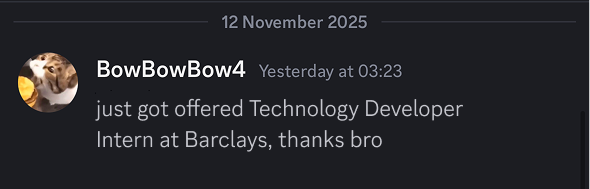
Stephen is one of hundreds of candidates inside the free community working on spring week and internship applications at Tier 1 banks. Join them for free.
Common mistakes to avoid
- Applying late. Places on a rolling process fill before the deadline. Last cycle closed on 23 November 2025, so a strong application in the first weeks beats a perfect one sent at the end.
- A motivation answer that could go to any bank. If you could swap in Barclays or Citi and it still reads fine, it is too generic. Anchor it to one division and one specific reason.
- A CV with no numbers. "Responsible for" tells the recruiter nothing. Show the result.
- No view on the markets question. You can expect it, so turning up without a story you can explain shows you did not prepare.
- Treating the programme as the prize. The spring week is not the finish line. Day 4 decides the internship, so prepare for it before you arrive.
Related guides
- Bank of America internship application process: every stage and the video interview
- Barclays Spring Week 2026: how to apply and get in
- JP Morgan Spring Week 2026: application process and HireVue questions
Where this leaves you
The Bank of America spring week is one of the few spring programmes that can turn straight into a summer internship, and that makes it worth preparing for properly. Register your interest now, apply in the first weeks, pick one division and build every answer around it, give the video interview 5 short answers that lead with the result, and treat Day 4 as the interview it is. Do that and you get through the stages where most people drop out.
If you have been applying to Bank of America and other Tier 1 banks without hearing back, the fix is rarely one more rewrite of the same application. It is an approach that gets you into the room. Join the free community with hundreds of other candidates working on spring week applications at Tier 1 banks right now. Join for free.
More candidate accounts
Other candidates who went through this process shared their experience with us. Each account below is one person's first-hand view of the stages, so details can differ by year and office.
Candidate 1: Spring Intern at Bank of America
Online Application
This will take between 30 minutes to an hour. It requires you to fill out your educational career, attained and projected grades, contact details and answers to questions related to Bank of America.
It is crucial to convey your suitability for the programme and the value that you would derive from it at every stage of your application process.
Virtual Interview
If you are successful in Stage 1 online application phase, you are invited by email to complete a virtual video recording interview. This interview is not live, the website prompts you with five interview questions, for which you are given 30 seconds to prepare your answer and two minutes to record yourself speaking.
How to respond for success
Dress professionally! Although virtual, it is still an interview that will be reviewed by BofA’s campus recruitment team. Before beginning the virtual interview, ensure that your webcam, microphone and internet connection are functioning properly. Set yourself up in a quiet place with good lighting and a tidy background where you will not be disturbed.
The interview was largely competency-based questions, i.e., questions prefaced with “name a time when you demonstrated....’. Prior to the interview, prepare some responses to these types of questions and practice saying them in the mirror in a confident tone. Be aware that you are given a maximum of two minutes to give your answer to these questions, but you can end your recording before the two minutes have ended. Jack recommends aiming to keep your answer in the 75-90 second range.
The final question asked Jack to talk about a recent news story in the financial markets that had interested him. In preparation for this question, try to find an interesting story that could have had implications for Bank of America, and talk in detail about your own opinions on the matter and what it could mean for the broader financial markets.
Expect a 1-week wait before progressing to the next stage.
Final Interview
This is the final stage of the application process. An analyst at the bank will call you by phone at a previously agreed time and date, usually in the evening due to the busy schedules of IB analysts.
Example task
These questions are generally not very technical, and follow the regular format of competency and motivation-based questions, e.g. What makes you want to work for Bank of America? Why have you applied to this division in particular? These questions are where your knowledge of the company and the lines of business are crucial, explain to the interviewer what sets Bank of America apart from other IB’s for you, and explain what interests you about the division that you have applied for.
How to respond for success
Prior to the interview, practice your responses to basic motivation and competency based questions by yourself. However, avoid preparing ‘scripts’ that you read off during the interview, as this tends to come off sounding very robotic and rehearsed and your interviewer will most likely pick up on it. Take some time to reflect on what you like about the company and why you would like to work there, and think about how you will demonstrate this enthusiasm in responses that sound authentic and genuine.
At the end of your interview, the interviewer will ask you if you have applied to similar programmes at any other banks. Avoid saying that you have applied to many / all of them, even if you have. This will, in the interviewer's mind, render everything you said about what sets Bank of America apart in-genuine. Jack recommends saying that you have also applied to JPMorgan and Goldman Sachs if you have because these are two American banks with similar values.
Expect a 2-week wait before receiving your offer!
Questions candidates ask
- What is the Bank of America spring week called?
- Bank of America calls its spring week the Spring Insight programme. The 2027 intake runs in London for Banking and Markets, Global Payments and Enterprise Credit, and Corporate Functions and Strategy, and in Chester for UK Operations. It includes spotlight sessions, simulations and networking, and ends with an assessment centre on Day 4.
- Can the Bank of America spring week lead to a summer internship?
- Yes. The final day of the Spring Insight programme is an in-person assessment centre, and people who perform well can be invited onto the summer internship, which runs from June to August 2027 for this intake. That makes it one of the most direct spring routes into a bank internship.
- Who can apply to the Bank of America Spring Insight programme?
- It is aimed at people in the first year of a 3-year degree or the second year of a 4-year degree. Last cycle asked for at least 112 UCAS points or equivalent and accepted any degree subject. You do not need a finance background, but you do need a specific, researched reason for choosing your division.
- What is in the Bank of America spring week video interview?
- It is a recorded interview with 5 competency questions. You get 30 seconds to prepare each answer and up to 2 minutes to record it. The final question is often about a recent story in financial markets, so have one ready with a clear view on why it matters to the bank.
- When do Bank of America spring week applications close?
- Recruiting is rolling, so places fill before the deadline. The last cycle closed on 23 November 2025. The 2027 listings are currently taking registrations of interest, so register on the careers site and apply as soon as the window opens.