Spring Week Investment Banking 2027: Who Can Apply, When, and How Each Bank Selects
Spring week investment banking guide for 2027: who can apply, when to apply, and how Goldman Sachs, J.P. Morgan, Barclays, Citi and BofA select.
By Oliver Cordingley ·
In brief
- Spring weeks are for people in the first year of a 3-year degree or the second year of a 4-year degree. Citi and Bank of America state this rule on their own careers sites, and Lancaster's careers team gives the same guidance.
- Opening dates vary by bank, and only Citi gives a window on the pages we checked: its London Spring Insight applications open in October or November. Lancaster's careers team advises applying in September and October.
- A published deadline is not the real deadline. Lancaster warns that places can all be allocated by mid-November, whatever the website says.
- Every bank tests something different: a 300-word motivational statement at Goldman Sachs, a values-based SJT and a numerical test at Barclays, 3 written motivation questions and 2 live interviews at Citi (as reported by candidates in OurGen's employer guides).
- The week itself can lead to a summer internship. Citi describes a pipeline to its summer internships "subject to performance", J.P. Morgan says participants may be considered for next steps linked to summer internships, and Bank of America offers a fast-track assessment that can lead to an internship.
A spring week in investment banking is a short insight programme, usually over the Easter break, for people early in their degree. It is the first door into the industry and, at several banks, a route towards a summer internship. This guide covers who can apply for a spring week investment banking programme, when applications open, and how the process works at Goldman Sachs, J.P. Morgan, Barclays, Citi and Bank of America. That way you prepare for the test each bank actually sets, rather than sending one application everywhere.
What is a spring week in investment banking?
A spring week is a short programme inside a bank where you learn what each division does and meet the people who work there. The careers team at Lancaster's management school describes the content as case studies, presentations, networking, technical training and work shadowing, usually held over the Easter break of your first year (Lancaster's guide to investment banking spring weeks).
The name varies by bank. J.P. Morgan now calls its programme Spring Insights and runs it as 5 skills-led pathways: technology, banking, markets, asset and wealth management, and the teams that help the firm operate. Citi calls its London programme Spring Insight: 4 days, on-site in London, in March or around Easter.
Who can apply for a spring week
The rule is about your year of study, not your degree subject:
- Citi: first year of a 3-year course or second year of a 4-year course. Citi says this applies whether you study in the UK or outside it.
- Bank of America: first year of your undergraduate degree, or second year if you are on a 4-year course.
- J.P. Morgan: frames it by timing. Spring Insights is for people planning to start a full-time career in 2 years' time.
- Lancaster's careers team: only first-years can apply, unless you are on a 4-year course, in which case second-years can apply too.
If you are in your penultimate year, you have missed the spring week window and should be applying for summer internships instead.
When spring week investment banking applications open (and why the deadline is not the real deadline)
Most spring week applications run in the autumn of your first year, but each bank sets its own dates. Lancaster's 2024 guide notes that some schemes open as early as July and August, so set alerts before term starts. Citi says its Spring Insight applications open in October or November, and Lancaster tells first-years to have their applications in by the end of October, with September ideal.
On the bank pages we checked on 26 November 2026, Citi was the only one of the 5 banks to give an application window. We found no published 2027 open or close dates for Goldman Sachs, J.P. Morgan, Barclays or Bank of America. J.P. Morgan's Spring Insights page says it only shows the locations where the programme is currently open, so check whether London is listed there.
The most useful line in Lancaster's guide is this one: ignore a stated December or January deadline. If a firm has 100 places and allocates them all by mid-November, the date on the website does not matter. Treat spring week recruitment as first come, first assessed.
Applying at the end of November?
Do not write the year off, but expect some programmes to have closed already. Open the careers portal of every bank on your list this week, and apply to each programme still accepting applications, strongest fit first.
Lancaster recommends 15 to 25 applications in total, without letting the quality of any single one drop. That only works if your CV, your "why this bank" paragraph and your story bank are ready first, so use the sections below to build them once, then reuse them.
The spring week application process at 5 banks
The stages differ a lot: Citi adds 2 live calls, while candidates describe a 2-stage process with no live interview at Goldman Sachs. This table combines what each bank publishes with what successful candidates reported in OurGen's employer guides. Treat the candidate-reported stages as a guide to prepare for, not a promise, because banks change their process between cycles.
| Bank | What the bank says | What candidates report (OurGen employer guides) |
|---|---|---|
| Goldman Sachs | No 2027 dates or eligibility rule found on its programmes page (checked 26 November 2026) | CV plus a 300-word motivational statement for up to 2 divisions, then a HireVue with 5 or 6 questions and around 30 seconds to prepare each |
| J.P. Morgan | Spring Insights: 5 pathways, for people starting full-time work in 2 years. Shows only locations currently open | CV and a cover letter (why investment banking, why J.P. Morgan, why you), then a recorded video interview of around 5 questions, including one on a recent news story |
| Barclays | Its 5 values are Respect, Integrity, Service, Excellence and Stewardship | CV, then a situational judgement test built on those values and a numerical test, then a HireVue of 6 questions with 2 minutes per answer |
| Citi | Spring Insight: London, 4 days, March or around Easter. Applications open October or November. A CV is required | CV, 3 motivation questions of up to 300 words each and an optional cover letter, timed tests, a 20-minute HR phone call, then a 30-minute Zoom interview with a manager |
| Bank of America | Spring Insight Programme: first year, or second year of a 4-year course. Includes a fast-track assessment that can lead to an internship | Online application of 30 minutes to 1 hour, a recorded virtual interview, then a final phone interview with an analyst, within about 3 weeks |
2 details catch people out. Citi's application system, Eightfold, manages pre-internship programmes as events, so the screen may say you are registering for an event. Citi says this is expected, and that an application without a CV will not be considered. Barclays tests its values directly, so read its 5 values before the SJT, not after.
For the full stage-by-stage breakdown at a single bank, see the Goldman Sachs spring week guide, the J.P. Morgan spring week guide with HireVue questions the Barclays spring week guide, the Citi spring week guide and the Bank of America spring week guide.
How to pass each stage of a spring week application
The written answers: why this bank, why this division
Almost every bank asks some version of "why us?", whether it is Goldman Sachs' 300-word statement, Citi's 3 motivation questions or J.P. Morgan's cover letter. Most candidates answer it with the bank's own website copy, which is exactly what every other applicant writes.
The fix I give in 1:1 coaching is to anchor the answer in something you actually did. A conversation with someone at the bank. A talk you attended. A specific interview or presentation the firm published. One candidate I coached had watched an interview in J.P. Morgan's own conversation series, but had not made that research visible in the opening of the cover letter. My advice was to name the source in the first line:
"The reason I'm applying for X role at X company is because I watched [their] presentation in J.P. Morgan's conversation series."
Then connect what you learned to how you work. That one specific source does more than 3 paragraphs about "a global leader in financial services".
For Goldman Sachs, the employer guide's advice is to lead with your preferred division and say why it appeals, then cover the second division briefly. Show you understand the difference between the 2.
The online tests
Lancaster's careers team names SHL, Kenexa and TalentQ as the main test providers, with SHL the most common. It also says investment banks always include numerical and logical reasoning. Barclays adds a situational judgement test on its values. In OurGen's guide, candidates describe its numerical questions as pulling from 6 to 8 tables, charts and graphs, where the hard part is picking the right data before you calculate anything.
My rule from the course: run 5 to 10 practice tests of each format you are likely to face before the real one. Speed and accuracy both improve with practice. Lancaster's careers team is blunt about the stakes: there is no progression if the tests go badly. If numbers are your weak point, I break down why most candidates fail numerical reasoning, and how to fix it, in this video.
The video interview
Goldman Sachs, J.P. Morgan, Barclays and Bank of America all use a recorded video interview at spring week stage, according to candidates in our guides. At Bank of America, candidates report 5 competency questions with 30 seconds to prepare and 2 minutes to answer, and the last question is often on financial markets news. The timings vary by bank, so practise to the clock you will actually face: around 30 seconds to prepare at Goldman Sachs, 2 minutes to answer at Barclays.
Structure every competency answer with CCARR: Context, Challenge, Action, Result, Reflection. The Reflection is the part most people drop, and it is what separates a first-year who did something from a first-year who learned from it. Use the prep time to pick the story and mark the 5 parts. Do not write a script, because read answers sound read.
Build a bank of 5 or 6 stories before you apply (a team project, a part-time job, a society role, a mistake, a time you persuaded someone), then map each to the questions you expect. For Barclays, map each story to one of its 5 values. Practise 10 to 15 questions on camera before the real thing. I walk through what HireVue is actually assessing, and how it scores your answers, in this video.
Hundreds of candidates inside the free community are working on spring week applications at Tier 1 banks right now, facing the same tests and video interviews you are preparing for. Join them for free.
Live interviews
Citi adds 2 live calls and Bank of America adds 1, according to candidates in our guides. At Bank of America, the final stage is a phone call with an analyst. For Citi, candidates report a 20-minute HR phone call followed by a 30-minute Zoom interview with a manager, mixing "tell me about a time" questions with "what would you do if" questions. The employer guide's advice: keep answers to 1 to 2 minutes, have your CV in front of you, and be ready to say why Citi specifically, not banking in general.
What happens during the spring week, and how it leads to an internship
The banks describe the week in similar terms. J.P. Morgan lists information sessions, networking, skills-based activities and simulated work experiences, and says participants may be considered for next steps linked to summer internships, depending on the pathway. Citi describes job shadowing with the business you choose and a pipeline to its summer internships, subject to performance. Bank of America lists networking, insight into its business areas, skills sessions and a fast-track assessment process that can lead to an internship.
Lancaster's 2024 guide puts the chance of being fast-tracked to a summer internship at broadly 50%, and says it varies from bank to bank. That is why the week is an assessment, not a holiday. Treat every session, case study and conversation as part of your application for the following summer.
Proof this works early in your degree
Stephen came to The Offer Accelerator going into second year with no real idea what to do beyond writing a CV, and unsure whether that CV was competitive for Tech and Finance internships. He secured a Technology Developer Internship at Barclays.
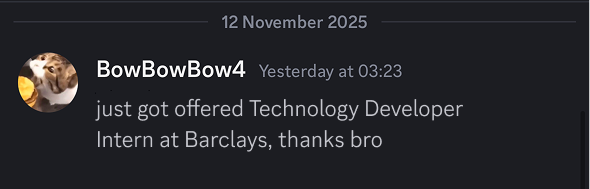
Stephen is one of hundreds of candidates inside the free community who have worked on Tier 1 bank applications. Join them for free.
Common mistakes in spring week applications
- Waiting for the deadline. Places can go by mid-November. Submit as soon as each application is ready.
- One "why us" paragraph for every bank. Goldman Sachs asks about divisions, Barclays tests its values, J.P. Morgan asks you to pick a pathway. Each needs its own answer.
- Skipping test practice. The online tests are a hard filter. 5 to 10 timed practice tests per format is the minimum.
- Answers with no Reflection. First-years rarely have big results to talk about. What you learned is often the strongest part of the answer.
- Applying in the wrong year. If you are in your penultimate year, the spring week route has closed. Apply for summer internships.
If your spring week applications are going nowhere, fix the application first
A spring week investment banking application is won on detail: the right year, an early submission, a "why us" answer anchored in something real, practised tests and structured video answers. If you have already applied to Tier 1 banks and heard nothing back, the fix is a sharper application, not a longer list. Join the free community with hundreds of other candidates working on spring week applications at Tier 1 banks right now. Join for free.
Questions candidates ask
- What is a spring week in investment banking?
- A spring week is a short insight programme at a bank, usually held over the Easter break, for people early in their degree. It combines presentations, networking, case studies and work shadowing. At Citi, for example, it runs for 4 days on-site in London.
- Who can apply for an investment banking spring week?
- At Citi and Bank of America, you must be in the first year of your degree or the second year of a 4-year course, and Lancaster's careers team gives the same rule. J.P. Morgan frames it as people planning to start a full-time career in 2 years' time. Your degree subject does not decide eligibility.
- When do spring week applications open for 2027?
- Most applications run in the autumn of your first year, and dates vary by bank. Of the 5 banks in this guide, only Citi gave a window when we checked on 26 November 2026. Lancaster notes that some schemes open as early as July and August. Citi says its London Spring Insight applications open in October or November. Lancaster's careers team advises applying in September and October, because places can be filled before the stated deadline.
- Do spring weeks lead to summer internships?
- They can. Citi describes a pipeline to its summer internships subject to performance, J.P. Morgan says participants may be considered for next steps linked to summer internships, and Bank of America has a fast-track assessment that can lead to one. Lancaster's careers team puts the chance of a fast-track at broadly 50%, varying by bank.
- How many spring weeks should I apply to?
- Lancaster's careers team recommends 15 to 25 applications, as long as the quality of each one holds up. Prepare your CV, story bank and test practice once, then tailor the "why this bank" answer for each application.